Loop Marketing vs Inbound Marketing: How They Work Together
Loop Marketing vs Inbound Marketing: How They Work Together
Loop Marketing vs Inbound Marketing
Loop Marketing vs Inbound Marketing helpful to compare these two frameworks side by side, because Loop Marketing doesn’t wipe inbound out — it builds on it.
What is Inbound Marketing?
Inbound Marketing taught us how to create helpful content (blogs, eBooks, webinars), attract the right audience, convert them via offers, and then delight them so they become promoters. The emphasis: attract first, then convert, then delight.
What is Loop Marketing?
Loop Marketing acknowledges that your buyer may show up on YouTube, TikTok, Reddit, or ask an AI assistant — not just your blog. It puts the customer at the centre and says: every move matters; every interaction is data.
Here’s a key comparison Of Loop Marketing vs Inbound Marketing:
| Feature | Inbound Marketing | Loop Marketing |
| Structure | Linear path: Attract → Convert → Close → Delight | Circular path: Express → Tailor → Amplify → Evolve |
| Focus | Primarily on acquisition and conversion | Balanced between acquisition, retention, expansion, advocacy |
| Channel mindset | Focused on blog/website + social + lead offers | Embraces AI, creator channels, multi-platform, omnichannel |
| Outcome | Transaction + maybe referral | Continuous growth: each loop builds momentum |
| Data use | Periodic measurement, campaign by campaign | Real-time learning; each cycle uses data to improve |
The takeaway of Loop Marketing vs Inbound Marketing : Inbound got us thinking about value, permission and pull. Loop takes that foundation and adds speed, data-integration and ongoing iteration.
How Loop Marketing Builds on Your Inbound Foundation In Loop Marketing vs Inbound Marketing
If you already have inbound marketing in place, you’re well-positioned to adopt Loop Marketing — think of it as stepping up rather than starting over. Let’s walk through how the inbound components map into Loop, using the four Loop stages In Loop Marketing vs Inbound Marketing .
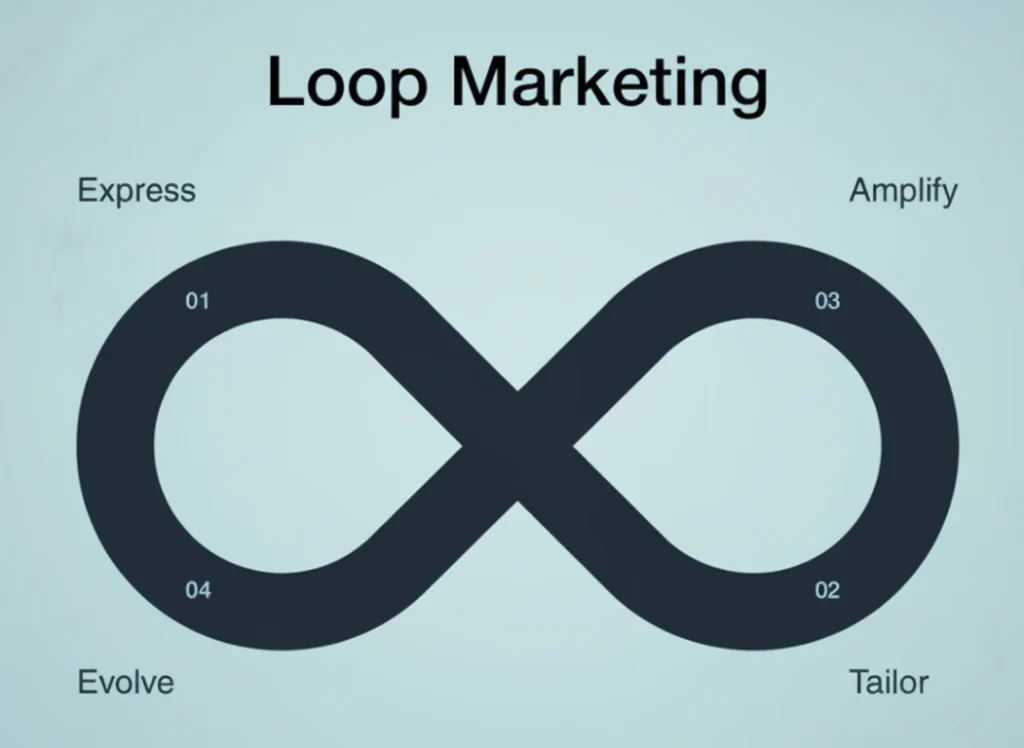
Express → Attract
With inbound, you probably created personas, blogs, lead magnets and SEO. In the Express stage of Loop Marketing, you put extra emphasis on brand identity: your voice, tone, unique perspective. Then you use that identity quickly and broadly.
For example: instead of waiting for a monthly blog, you might launch short-form videos or micro-content on new channels. You emphasise clarity around who you are and what stands you out. (Tailored for AI-driven discovery and modern search.)
Tailor → Convert/Close
Inbound taught lead nurturing and workflows. Loop amplifies this by emphasising real-time personalization and unified data. When you collect info from sales, service and marketing systems, you can tailor the message to what the person already did, said or sought. That means closing is smoother and post-sale touchpoints are smarter.
Amplify → Attract/Engage Across Channels
Inbound often focused on owned channels (your blog, email list). Loop demands a broader reach. You amplify your message across creator networks, niche platforms, AI assistants, emergent media. The idea: go where the buyer is, not wait for them to find you.
Evolve → Delight/Optimize
Inbound finishes with delight and some optimization. Loop takes things a step further. You test things, see what sticks, and try again. Some ideas work, others don’t — but each time, you notice something new. After a few rounds, you start to see patterns. The whole thing just gets sharper without you even planning it that way. Before long, your growth starts to build on its own.
Thus, inbound is your steady foundation; Loop is the lever that multiplies it.
Key Comparison: Loop Marketing vs Inbound Marketing
While we touched on comparison Of Loop Marketing vs Inbound Marketing above, here are some deeper contrasts and implications Of Loop Marketing vs Inbound Marketing:
Lifecycle scope – Inbound often ends at conversion + delight; Loop keeps going — from advocacy back to expression.
Speed – Most inbound teams still plan around set campaigns — maybe a quarterly promo or a seasonal push. Loop marketing isn’t like that. It keeps moving. You test one thing, change another, see what sticks, and try again next week. It’s more of an ongoing habit than a scheduled event.
With inbound, you might think mainly about a few familiar places — your blog, your website, your email list. Loop takes a wider view. It’s about showing up wherever people are looking or talking — that could be AI-generated answers, influencer content, or small community apps most brands ignore.
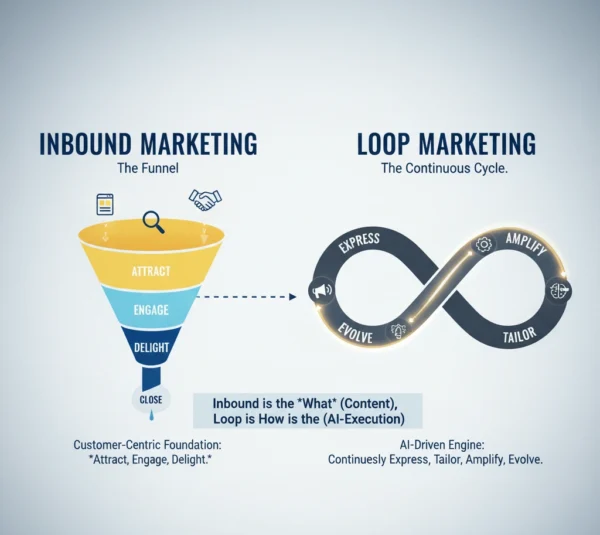
And when it comes to data, inbound usually looks at what’s inside your CRM or marketing tools. Loop doesn’t stop there. It connects everything — sales insights, customer support notes, even feedback from reviews — and feeds it all back into your next move.
Mindset change – Inbound emphasizes “get found and convert”. Loop emphasizes “engage, learn, improve, loop”.
Organizations still clinging purely to inbound may find themselves reactive instead of proactive; Loop marketers are anticipatory.
How Loop Marketing Builds on Your Inbound Foundation In Loop Marketing vs Inbound Marketing
et’s slow down and look at how the Loop fits over what you already know from inbound In Loop Marketing vs Inbound Marketing.
Express → Attract
This is where you get clear about who you are and what you stand for. Before you start sending messages or tweaking ads, make sure your brand’s voice actually sounds like you. It’s not about big taglines or slogans — it’s about being consistent every time someone runs into your brand. When people recognize your tone or approach right away, attraction happens naturally.
Ask: What promise do we make? What tone do we take? Once that’s clear, express it consistently across channels.
Since inbound already gave you personas and content assets, you can accelerate: repurpose blogs into micro-videos, turn FAQs into AI friendly snippets, test short bursts on new channels. The goal is to attract attention rapidly and clearly.
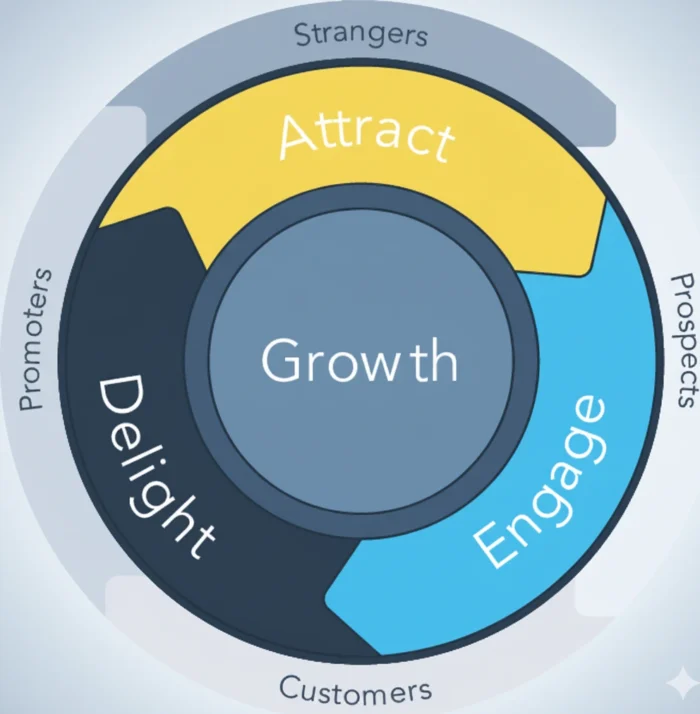
Tailor → Convert/Close
Here you deepen the relationship. Use the data you have: what did they download, what pages did they visit, what questions did they ask? Tailored messages mean you speak to the person, not a generic “you”.
This translates to personalization in nurture flows, dynamic offers, behaviour-triggered messages—and sales/service alignment to close and deliver value.
Amplify → Attract/Engage Across Channels
Now you push your message wider. But amplification in Loop means more than ads. It means leveraging creators, podcast clips, community content, emergent platforms, and ensuring your message is discoverable even when your brand name isn’t present. The more touchpoints you get, the stronger your loop becomes.
Evolve → Delight/Optimize
Finally, you don’t stop after you “close the deal.” You monitor performance, pull in service and success data, run small tests, adjust offers, update segmentation. Improsvement happens continuously. Then you feed new insights back into Express. That’s the loop.
Common Pitfalls When Shifting From the Flywheel to Loop Marketing vs Inbound Marketing
Moving from inbound or even a flywheel model to Loop Marketing vs Inbound Marketing can be powerful — but only if you avoid certain traps:
- Thinking it’s just a re-labelled funnel
If you treat Loop as simply another funnel rename and stick to “campaign → done” thinking, you’ll miss the core shift: continuous cycles. - Ignoring data readiness
Loop demands unified data across marketing, sales, service. Without that, your Tailor and Evolve phases fail.
growthloop.com - Sticking to old channels
If you rely solely on your blog and email list and ignore creators, AI answer-engines or emergent platforms, you’ll plateau. - Waiting too long to iterate
Loop requires speed. Running one major campaign per quarter won’t cut it anymore. Continuous testing is key. - Lack of alignment between teams
Marketing, sales, service must work together. If they stay siloed, the loop falls apart. - Underestimating investment in tools and skills
While not always about budget size, Loop does require stronger data, AI or at least analytics, multi-channel chops.
Frequently Asked Questions About Loop Marketing vs Inbound Marketing
Q1. Does Loop Marketing replace Inbound Marketing?
No. Inbound is still the backbone. Loop just builds on it. Think of inbound as your foundation — blogs, emails, lead magnets — all that good stuff. Loop adds motion. It keeps things from going stale. You’re not throwing out inbound; you’re making it more flexible.
Q2. Can I start Loop Marketing without doing inbound first?
You can, but it’s not ideal. If you don’t have basic things like buyer personas, a content plan, or an email flow, you’ll end up guessing. Inbound gives you those base layers. Once you have them, Loop helps you move faster and adjust as you go.
Q3. Who gets the most from Loop Marketing?
Any business that depends on long-term relationships. Agencies, SaaS products, service firms — anyone who needs people to stick around. If your work involves repeat engagement or renewals, Loop helps you stay present and relevant.
Q4. How do I track if it’s actually working?
You’ll see it in how quickly you can adjust. Campaigns don’t drag on for months; you can tell what’s working within days. Look at your repeat customers, conversion time, and even small efficiency gains. The shorter your learning curve, the stronger your loop.
Q5. What about the old flywheel idea — is that still useful?
Sure, it still makes sense. The flywheel shows momentum. Loop just adds what the flywheel missed — feedback. Instead of spinning endlessly, it learns from each turn. That’s the big difference: motion with memory.
Keeping Your Strategy “In the Loop Marketing vs Inbound Marketing”
If you’re still running campaigns by the calendar, you’re missing the rhythm of how people actually buy now. Things move fast. Waiting three months for the next “big push” doesn’t cut it anymore.
Start with something small — maybe a single newsletter sequence or an ad test. Watch what happens. Fix what doesn’t land. Try again. That’s it. You’re looping.
It’s less about big moments and more about steady movement. Every loop teaches you something new. You begin to see patterns, the kind that only appear when you’re watching closely. That’s how momentum builds — quietly, almost invisibly at first, then all at once.
Loop Marketing vs Inbound Marketing isn’t a trend. Loop Marketing vs Inbound Marketing just a way of working that matches how things really move online — always changing, never quite settled. Once you fall into that rhythm, the old “start-stop” kind of planning feels outdated.
Explore more growth-driven strategies in our latest post: Top Email Marketing Tools for Financial Services
Comment (1)
12 Great Examples of Welcome Emails for New Customers
05 Nov 2025[…] Want to learn how marketing loops can boost engagement? Check out our detailed guide on Loop Marketing vs Inbound Marketing. […]