Stop Guessing: Here’s How to Use AI Tools for Personalized Marketing Campaigns
Stop Guessing: Here’s How to Use AI Tools for Personalized Marketing Campaigns
Let’s not mince words: generic marketing campaigns are dead weight. Your customers are exhausted by irrelevant ads and boring emails. In today’s hyper-competitive landscape, knowing how to use AI tools for personalized marketing isn’t just an advantage—it’s survival. If your brand messaging doesn’t feel like a genuinely helpful, perfectly timed suggestion, you’re losing money. It’s that simple.
Now, achieving this level of surgical precision across millions of individual customer journeys? Good luck doing that with spreadsheets and manual segmentation. It’s impossible. This is precisely why AI tools have become non-negotiable. They aren’t going to steal your creative job; they are here to manage the crushing weight of data analysis and real-time execution that no human team could ever handle. They let your smart people be brilliant strategists instead of glorified data entry clerks.
You want a roadmap? Here it is.
Phase 1: How to Use AI Tools for Personalized Marketing to Build a Strong Foundation — Cleaning Up the Mess
If you want to learn how to use AI tools for personalized marketing effectively, this is where it starts — and for many brands, it’s not pretty. Your customer data is likely scattered across CRMs, e-commerce platforms, website analytics, and maybe even spreadsheets. No single system holds the full story. And trying to feed that chaotic data into an AI tool? That’s like fueling a Tesla with mud — it’s not just useless, it’s damaging.
Your immediate, critical investment must be in a Customer Data Platform (CDP). This is not optional. The CDP’s entire mission is to be the ultimate data bouncer: it ingests all the raw, conflicting data, ruthlessly deduplicates everything, and knits those scattered identifiers (cookies, loyalty IDs, emails) into one unified Golden Record. Your AI models absolutely must be trained on this clean, rich, unified data. Seriously, get this right, or the entire personalization project collapses.
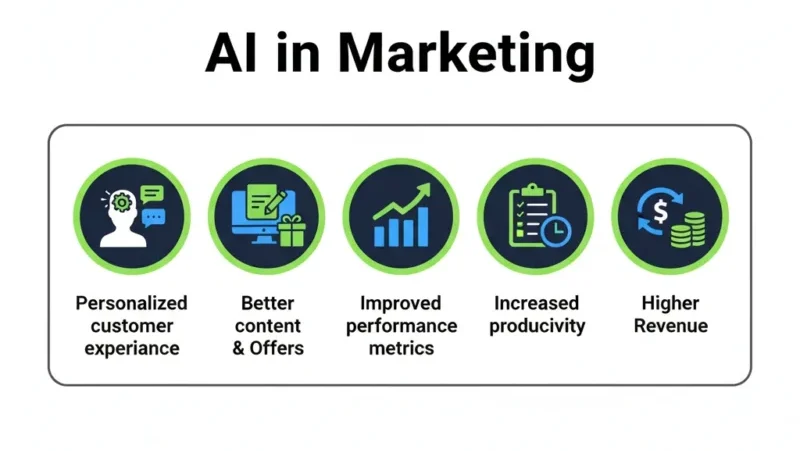
Phase 2: How to Use AI Tools for Personalized Marketing to Master Predictive Segmentation
If you’re still relying on static segments like “30-50 year olds who bought once,” you are marketing with a rearview mirror. AI slams the door shut on that archaic practice. It introduces predictive and behavioral segmentation driven entirely by Machine Learning (ML).
The AI doesn’t care about simple demographics. It cares about propensity. It uses complex algorithms, like clustering, to dynamically identify micro-segments based on shared behavioral signals that are almost invisible to the human eye. Think about it: a small group that browses premium products at 2 AM, engages only with long-form video content, and is 90% likely to purchase within the next three days. That’s money right there.
The real game-changer is predictive scoring. The AI assigns a probability score to every single user: What is their forecasted Lifetime Value (LTV)? What’s the likelihood they will churn next month? This intelligence allows your system to instantly shift resources—offering a VIP incentive to a high-LTV customer, or deploying a targeted win-back campaign to a high-risk user. It’s about being proactive, not reactive.
Phase 3: Real-Time Precision Execution In Personalized Marketing Campaigns
You’ve got the clean data and the predictive insight. Now, how do you deliver? You need AI to handle the execution across multiple channels simultaneously.
A. Dynamic Creative and Ad Assembly
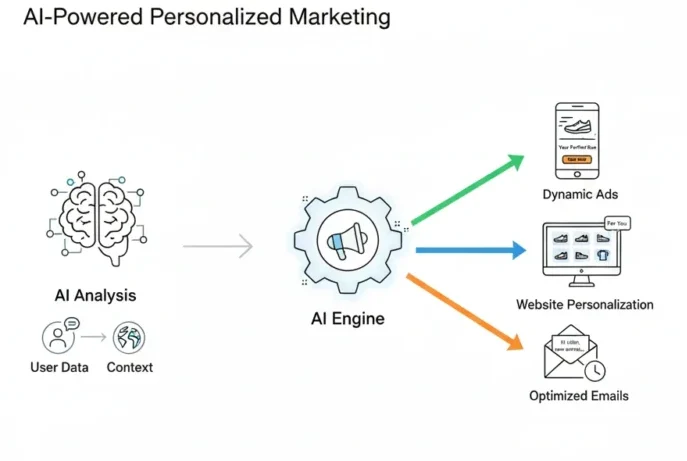
In programmatic advertising, we use Dynamic Creative Optimization (DCO). Forget running a few A/B tests on static ads. The AI takes over the assembly line. It chooses the right headline, the most persuasive image, and the most effective Call-to-Action (CTA) in the literal moment the ad is served. The AI makes the decision based on the individual user’s browsing history, location, and predictive score. It’s hyper-relevant, and it converts far better than anything you could manage manually.
B. Recommendation Engines That Aren’t Embarrassing
Your website can’t just slap up a “You May Also Like” banner anymore. AI personalization engines use sophisticated collaborative filtering (“Customers like you who viewed this also purchased…”) to turn your generic e-commerce site into a highly curated boutique. If a user always shops the clearance section, the AI filters results to emphasize value. If they are a first-time browser, it might offer educational content and a signup incentive. This boosts Average Order Value (AOV) and makes the customer feel genuinely understood.
C. Optimal Send Time (OST)
Seriously, if you’re still sending batch emails at 10 AM on a Tuesday, stop. AI analyzes every single customer’s individual inbox behavior to calculate their Optimal Send Time. It knows John opens emails at 7:15 AM before his first meeting, but Jane reads hers at 8:45 PM while watching TV. This simple, elegant personalization is surprisingly effective at boosting Open and Click-Through Rates (CTR).
Phase 4: AI as a Loyalty Builder (Service)
Personalization isn’t just for driving sales; it’s a monumental tool for building lasting relationships. AI-powered chatbots are the key here. Using advanced Natural Language Processing (NLP), they can decipher complex or frustrated customer inquiries.
The real trick? The bots are hooked into the Golden Record. They don’t have to ask for an order number or customer ID. They already know. They can instantly suggest the correct replacement part based on a product purchased a year ago, or proactively handle a shipping delay without a customer even asking. This use of AI transforms the support function from a frustrating cost center into a powerful, loyalty-driving personalized service. It’s a massive win.
Frequently Asked Questions (FAQs)
Q1) What’s the biggest mistake a company makes when starting with AI personalization?
The absolute biggest mistake is jumping straight to complex predictive modeling before getting their data unified and clean. You cannot skip Phase 1. If you try to model future behavior on incomplete historical data, your AI will simply reinforce bad insights. Start simple with data clean-up, then scale.
Q2) How quickly will I see an ROI from these tools?
It varies a lot. You might see an immediate, tangible lift in email engagement metrics from simple AI-based send-time optimization within just two to three weeks. However, for deep strategic projects like optimizing Customer Lifetime Value (LTV) across the entire funnel, you need to be patient. Budget four to six months for the AI models to fully train, learn, and deliver statistically significant financial results.
Q3) Does AI make my creative team redundant?
Are you kidding? No! AI handles the math and the mechanics—telling you who, when, and what product to show. Your human creative team is indispensable for the strategy, the tone of voice, the emotional connection, and the final compelling execution (the copy, the photography, the overall brand story). AI just gives their creativity a massive, accurate amplifier.
Q4) How do I avoid the terrifying ‘creepy’ factor?
The key is focusing on utility. Personalization is helpful when it clearly solves a customer problem (“Here’s a discounted filter for the air purifier you bought six months ago”). It’s creepy when it just feels like manipulation (“We saw you view this one product, and now it’s haunting your screen everywhere you look”). Always be transparent about data usage, and ensure your personalized efforts provide genuine value, not just aggressive sales pressure.
Want to ensure your meticulously crafted personalized campaigns actually get seen? Dive deeper into how to optimize your digital presence with our latest insights on Top SEO Trends to Boost Your Marketing.
Comment (1)
Zero-Click Searches 2025: 9 Proven Ways to Boost Traffic
22 Oct 2025[…] Want to see how AI tools are driving personalized marketing success? Check out our detailed guide here […]