SEO vs Paid Ads for E-Commerce: Which Works Better in 2026?
Most e-commerce owners I speak to lately are stuck on the same problem: should they keep burning money on ads or finally take SEO seriously?
“Should I invest in SEO… or should I just run ads?”
It’s a fair question. Actually, it’s one of the most common questions in e-commerce marketing right now. Ad costs are rising. Search engines are changing. AI is everywhere. And everyone online seems to have a different opinion.
Some marketers swear SEO vs Paid Ads for E-Commerce is the only sustainable way to grow. I keep hearing people say organic traffic is “dead” and that ads are the only way to get sales now.
The truth? It’s not that simple.
In this blog, I’m not going to give you textbook definitions or polished marketing slogans. I’m going to talk about what actually works in the real world of e-commerce in 2026, especially if you’re not a massive brand with unlimited budget.
The Reality of E-Commerce Marketing in 2026
Let’s start with the environment we’re working in.
In 2026:
- Almost every product niche is crowded
- Customers are smarter and more impatient
- Google uses AI to summarize answers
- Social platforms push paid content harder than organic
- Ad platforms rely more on automation than manual control
This means visibility is harder to earn and easier to lose.
So when people ask “SEO vs Paid Ads for E-Commerce,” what they’re really asking is:
“Where should I put my limited time and money so I don’t waste it?”
What SEO Really Looks Like for E-Commerce Today
SEO in 2026 is very different from SEO five or ten years ago.
It’s no longer about stuffing keywords or building random backlinks. For e-commerce, SEO today is about being genuinely useful at every step of the buying journey.
In practical terms, this means:
- Product pages that actually answer buyer questions
- Category pages that are easy to navigate and fast to load
- Blog content that helps users decide, compare, or learn
- Clear structure so AI search systems understand your site
When someone searches for a product, Google wants to show results that feel trustworthy. Organic results still carry a sense of credibility that ads simply don’t.
That trust matters more than most people realize.
The Slow Start Problem with SEO
Let’s be honest for a moment.
SEO is frustrating at the beginning.
You publish content. You optimize pages. You wait. And… nothing happens. Weeks pass. Sometimes months. This is where most people quit.
But here’s what many e-commerce owners don’t realize:
SEO works like compound interest.
Once your pages start ranking, they don’t just bring traffic for a day or a week. They can bring traffic for years with small updates.
That’s why people who stick with SEO vs Paid Ads for E-Commerce long enough rarely want to give it up.
What Paid Ads Actually Do for E-Commerce
Paid ads are the opposite experience.
You launch a campaign, and suddenly:
- Your store gets visitors
- You see clicks, impressions, maybe sales
- Everything feels fast and exciting
This instant feedback is why paid ads are so attractive.
In 2026, paid advertising is heavily AI-driven. Platforms decide:
- Who sees your ad
- When they see it
- How much you pay
You don’t control things the way you used to.
Paid ads are powerful, but they’re also unforgiving. If your product, pricing, or landing page is weak, the money disappears very quickly.
The Hidden Cost of Paid Ads No One Talks About
Here’s something many guides don’t mention.
Paid ads don’t just cost money. They cost attention and focus.
You’re constantly:
- Watching dashboards
- Adjusting budgets
- Testing creatives
- Reacting to performance drops
For small e-commerce teams, this mental load is real.
And in 2026, with rising CPCs, even a small mistake can wipe out margins.
SEO vs Paid Ads: The Ownership Question
This is usually the point where things finally click for people.
SEO feels slow at first, so it’s easy to underestimate it. But over time, you’re not just chasing traffic — you’re building something that actually belongs to you. Your content lives on your site. Your pages start ranking on their own. Your brand slowly becomes familiar to people who search again and again.
Paid ads don’t work like that.
With ads, you’re basically renting attention. As long as you keep paying, your store stays visible. The moment you pause the budget, everything goes quiet. No traffic. No impressions. Nothing.
That doesn’t make ads bad. It just means they’re temporary by nature.
SEO, on the other hand, keeps working in the background. Even on days when you’re not actively doing anything, the content you created months ago can still bring visitors and sales. That sense of ownership is the real difference most people only understand after they’ve spent money on ads for a while.
There’s nothing wrong with borrowing attention. But it’s important to understand the difference.
SEO builds assets.
Paid ads rent exposure.
Once you see it this way, decisions become clearer.
Cost Comparison in 2026 (The Honest Version)
Let’s talk money.
Running ads in e-commerce right now isn’t cheap at all. Too many brands are fighting for the same clicks, and the platforms keep pushing bids up.
SEO also costs money, just differently:
- Content creation
- Technical fixes
- Tools and audits
The difference is how that money behaves over time.
SEO costs tend to stabilize. Paid ad costs tend to increase.
That’s why many e-commerce businesses slowly shift more budget toward SEO as they grow.
Traffic Quality: Why Intent Matters More Than Volume
Not all visitors are equal.
Someone who searches:
“Best running shoes for flat feet”
is very different from someone who sees an ad while scrolling social media.
SEO usually brings people who are already thinking about buying. Paid ads often introduce products to people who weren’t actively searching.
Both are useful. But they serve different stages of the funnel.
In many stores, organic traffic converts better—not because it’s magic, but because intent is higher.
The Trust Factor (Still Underrated)
Here’s a simple observation.
Many users skip ads.
Not always consciously. Sometimes it’s just habit.
Organic results feel earned. Ads feel promoted.
Let’s be honest, people don’t blindly click ads like they used to. Too many bad stores ruined that trust, and organic results still feel more reliable.
Short-Term Wins vs Long-Term Stability
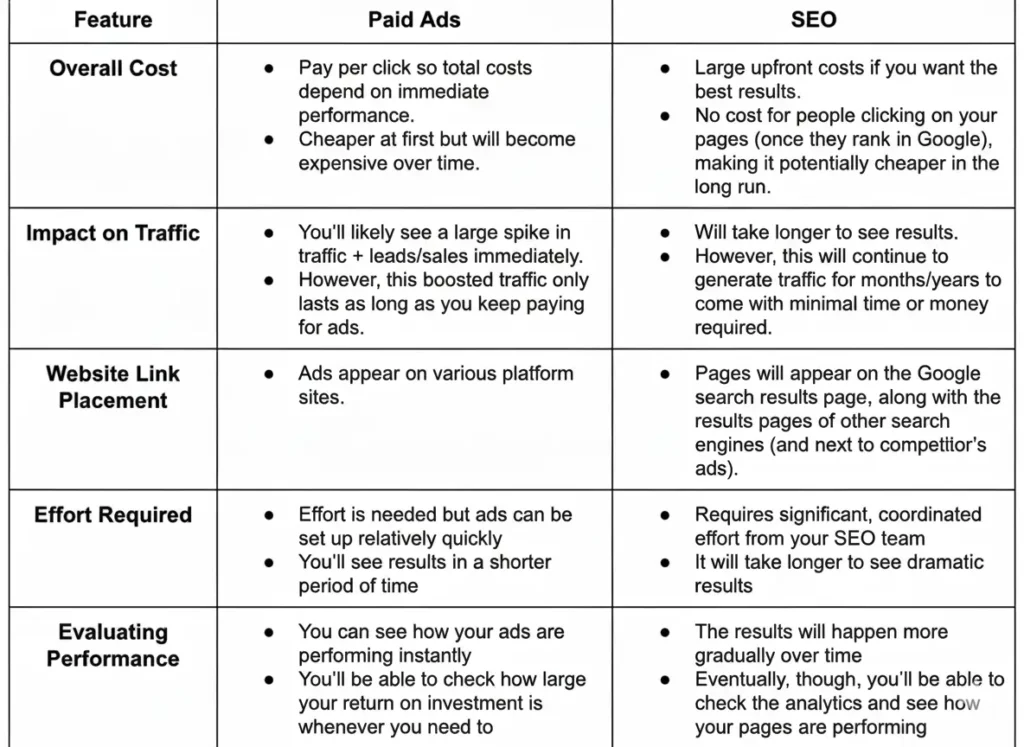
Paid ads shine in short-term situations:
- New product launches
- Seasonal sales
- Limited-time offers
SEO shines in long-term scenarios:
- Evergreen products
- Brand building
- Predictable monthly revenue
Problems start when businesses use paid ads for long-term stability or expect SEO to deliver instant results.
Each tool has a job. Confusing those jobs leads to disappointment.
AI Search Is Changing SEO (But Not Killing It)
Yes, AI summaries reduce clicks for some queries.
But for e-commerce, people still click.
Why?
AI can give quick answers, sure, but it doesn’t shop the way people do. Most people don’t buy the first thing they see. They scroll, open a few tabs, check prices, and slowly decide which store feels safe enough to trust. That’s why SEO now is less about gaming Google and more about actually being a decent option when someone is ready to buy.
Privacy Changes and the Future of Paid Ads
Privacy updates have quietly reshaped paid advertising.
Less tracking means:
- Less precise targeting
- More reliance on platform AI
- Fewer insights into user behavior
This doesn’t kill paid ads—but it does make them harder to control.
SEO doesn’t depend on tracking users across the web. That’s one reason organic strategies are becoming more valuable again.
Which One Is Better for Your E-Commerce Business?
Here’s the honest answer.
If you need sales this month, paid ads help.
If you want sales next year, SEO helps.
New store? Use ads to test products and messaging.
Established store? Invest in SEO to reduce dependency on ads.
Most successful brands don’t choose. They balance.
Why Mixing SEO and Paid Ads Actually Makes Sense
SEO gives you stability.
Paid ads give you speed.
Most brands stop there… but that’s only half the picture.
When you run both together, a few important things happen:
- You don’t depend on one traffic source
- Your data gets clearer (and more useful)
- Your brand starts showing up everywhere, not just once
SEO quietly tells you what people actually care about.
Paid ads let you push harder on what’s already working.
That connection is what a lot of businesses miss.
SEO: The Honest Pros and Cons
SEO works well because:
- Traffic builds on itself over time
- People trust organic results more
- Your cost per click slowly drops the longer you stick with it
But SEO can be frustrating because:
- It’s slow in the beginning (sometimes painfully slow)
- There are no instant guarantees
- Google doesn’t owe you results just because you “did everything right”
It’s a long game. And not everyone has the patience for it.
Paid Ads: The Honest Pros and Cons
Paid ads work because:
- You can get traffic almost immediately
- Scaling is fast if something converts
- Testing ideas is simple and measurable
But paid ads also have problems:
- Costs almost always go up over time
- Profit margins can shrink quickly
- It’s easy to become dependent on ad spend
Once you turn ads off, traffic often disappears with them.
SEO vs Paid Ads in 2026?
If you’re trying to pick a winner, you’re already asking the wrong question.
People keep asking whether SEO or paid ads matter more.
Honestly, it depends on what you’re trying to fix.
SEO is great when you’re thinking long-term. It helps you grow without constantly paying for every click. Over time, it creates stability. People also tend to trust organic results more — even if they don’t say it out loud, they behave that way.
Paid ads are different. They’re useful when you need traction now. You want control. You want to test fast, change things quickly, and see results without waiting months. That’s where ads shine.
The problem starts when businesses treat this like a competition.
SEO vs ads.
One or the other.
Winner takes all.
That’s usually where things break.
Rely only on SEO, and you’ll probably get impatient waiting for results.
Rely only on ads, and costs slowly start eating into your margins.
Neither approach is wrong on its own. Putting all your faith in just one is.
Final Thoughts
By 2026, e-commerce isn’t really about hacks anymore. Most of those stopped working years ago. What matters more is understanding how people actually move — how they discover products, disappear for a while, come back, compare, hesitate, and then finally buy.
SEO helps you show up during that journey.
Paid ads help you speed parts of it up.
Think of SEO as groundwork. It’s not exciting, and it takes time, but everything else sits on top of it. Paid ads just help you push harder when something’s already working.
The brands doing well aren’t guessing. They’re not blindly “doing both.” They know exactly why they’re using SEO, and exactly why they’re spending on ads.
That clarity matters more than the channel itself.
FAQs : SEO vs Paid Ads for E-Commerce
Is SEO actually still working for e-commerce in 2026?
Yes. It’s slower than ads, but it still works. People are still searching before buying, especially when they don’t trust a store yet.
Why do ads feel like they stop working after some time?
Because they only work while you pay. Once the budget pauses, traffic disappears. That’s the part most people don’t think about early on.
Can I survive without running ads at all?
Some stores do, but it takes time. SEO needs patience. If you want sales fast, ads help. If you want stability, SEO matters more.
Are ad costs really that high now?
For most niches, yes. Competition is heavy and AI bidding keeps pushing prices up. Small mistakes get expensive very quickly.
Do people still trust organic results more than ads?
Most of the time, yes. Many users skip ads without even thinking about it. Organic results just feel safer.
Is organic traffic really “dead”?
No. It’s just harder to earn than before. Bad stores and scams killed trust, not SEO itself.
How long before SEO starts bringing sales?
Usually months, not weeks. That’s why many people quit too early and say it “doesn’t work.”
Does organic traffic convert better?
Often it does. People coming from search are already comparing and deciding. They’re not being interrupted.
Can AI search replace e-commerce websites?
Not really. AI can explain things, but people still want to browse, compare prices, and decide which store feels legit.
What’s the biggest mistake store owners make with ads and SEO?
Expecting fast results from SEO and expecting long-term results from ads. That mix-up causes most frustration.
Want to dive deeper into how digital marketing is transforming e-commerce sales in 2026? Check out our detailed guide here.